
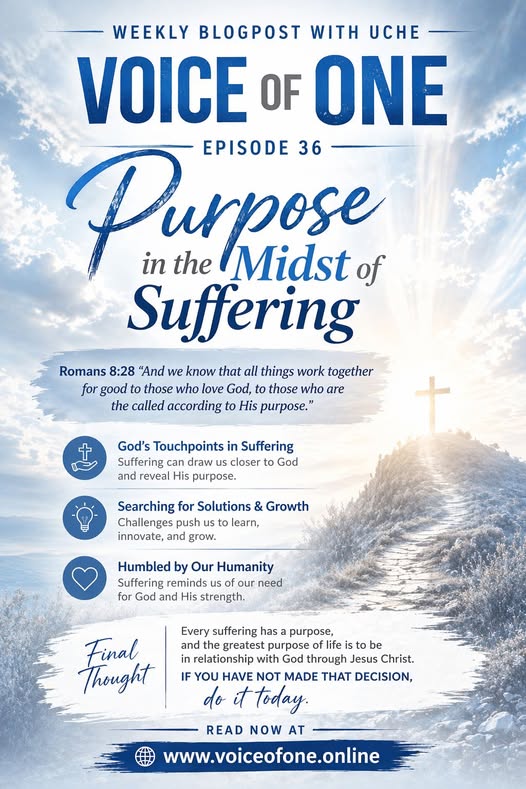
Romans 8:28 (NKJV)
“And we know that all things work together for good to those who love God, to those who are called according to His purpose.”
I recently attended a live event where an atheist was debating a Muslim who had converted to Christianity. It was fascinating to observe how the atheist tried to disprove the existence of the God of the Bible, after once identifying as a Christian. His primary reason for leaving the faith was that God no longer made logical sense to him. He desired tangible evidence and clear explanations—especially in light of what he perceived as contradictions in Scripture and inconsistencies in the lives of many Christians around him.
On the other hand, the Muslim convert touched on a profound truth that leads into this discussion: the question of suffering. Why does suffering exist in this world? Why does God allow it—or even seem to permit it? Is there any justification for it?
Before going further, this message does not make light of anyone’s pain. Whether it is death, war, injustice, loss, hunger, delays, or disappointments—your experience is real and valid. Rather, this is a message of hope: that even in suffering, God is present, and purpose can still emerge.
Suffering Can Be God’s Touchpoint to Humanity.
As Christians, we trace the origin of suffering back to sin—when humanity first disobeyed God. Through that disobedience came the reality of cause and effect, and the painful consequences of sin.
Consider also the story of the Tower of Babel. Humanity chose to act outside of God’s design, seeking to establish their own way rather than follow His command to fill the earth. Throughout Scripture and life, whenever divine order is ignored—whether in relationships, morality, or how we live—there are often consequences that can lead to suffering and disorder.
When life becomes difficult, people begin to seek solutions beyond themselves. Especially when situations exceed our understanding, suffering often pushes humanity to search for something greater. This is why it can be said: problems and suffering may never fully disappear in this world, because they create opportunities for humanity to seek their Creator.
Suffering Drives the Search for Knowledge and Solutions.
Suffering, though painful, has also contributed to human progress. Many innovations exist because of problems that need solutions. The desire to overcome limitations has led to discoveries and inventions that shape our daily lives.
For example, the need to communicate across distances led to the invention of the telephone, and eventually to smartphones. Yet, even as solutions arise, new challenges emerge—such as concerns about pollution and technology’s impact on society.
In this way, suffering and problem-solving often move in cycles. But within that cycle lies growth, learning, and advancement.
Suffering Humbles Humanity.
No matter how advanced or accomplished we become, we remain human—fragile and limited. At our very best, we still encounter pain, sickness, and challenges.
Scripture reminds us that life is like a vapor, here today and gone tomorrow. Suffering humbles us and reminds us of our need for help beyond ourselves. As Psalm 121 teaches, our ultimate help comes from the Lord.
We cannot truly live independently of God. Even those who question or deny Him may, at some point, encounter situations that lead them to seek something greater. And it is my prayer that in such moments, they encounter God through Jesus Christ.
Final Thought
Every experience of suffering can carry purpose—even when that purpose is not immediately clear. And ultimately, the greatest purpose of life is relationship with God through Jesus Christ.
If you have not made that decision, today is an opportunity to begin.
Love you all.